Software
Software and research code from our group. Filter by topic or type, or search by name or feature. The code is also on GitHub.
DIAL
 GitHub
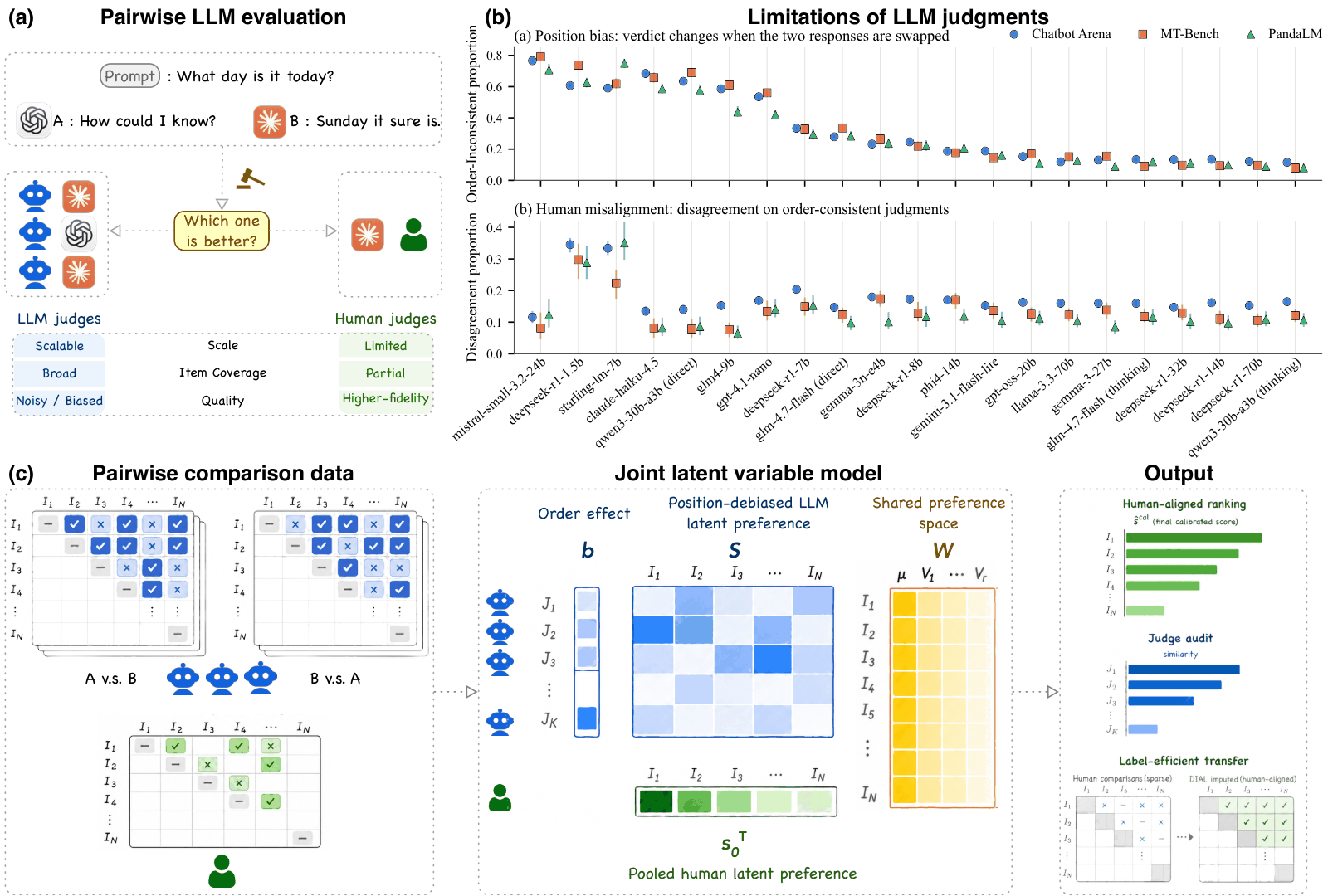
DIAL removes position bias from LLM judges and calibrates them to limited human preferences. It fits a joint latent variable model to pairwise comparisons from a panel of LLM judges, where each response pair is judged in both orders. It then calibrates the debiased judge preferences to a small budget of human comparisons. The repository provides the code and data for the paper.
- Position Debiasing: Estimates a judge-specific order effect from both presentation orders, so verdicts no longer depend on which response is shown first.
- Adaptive Human Calibration: Links LLM and human latent preferences through a shared low-rank preference space, turning a few human comparisons into a human-aligned ranking.
- Judge Audit and Label-efficient Transfer: Measures how similar each judge is to human raters, and imputes human-aligned comparisons for pairs that were never labeled.
- Reproducible Benchmarks: Includes the prepared Chatbot Arena, MT-Bench, and PandaLM benchmarks, every collected judge response, and scripts for all paper figures.
crispyx
crispyx is a Python package for streamlining genome-wide CRISPR screen analysis. It streams data directly from on-disk AnnData (.h5ad) files, so quality control, normalization, pseudo-bulk aggregation, and differential expression all run without loading the full count matrix into memory. This makes it possible to analyze even the largest screens on commodity hardware.
- Streaming QC & Preprocessing: Filters cells, perturbations, and genes; normalizes and log-transforms, all without materializing the full matrix in memory.
- Differential Expression: Supports t-test, Wilcoxon rank-sum, and negative binomial GLM with apeGLM LFC shrinkage; multi-core support and adaptive memory management.
- Pseudo-bulk Aggregation: Computes average log expression and pseudo-bulk count matrices for effect size estimation.
- Scanpy-compatible API & Plotting: Familiar
cx.pp,cx.pb,cx.tl, andcx.plnamespaces with Scanpy-style plots, and HPC-ready checkpointing with configurable memory limits.

VITAE
VITAE (Variational Inference for Trajectory Analysis by AutoEncoder) is a method for inferring developmental trajectories from single-cell RNA-seq data. It integrates and aligns single-cell data from different modalities such as chromatin accessibility and gene expression.
- Trajectory Inference: Accurately infers developmental trajectories and pseudotime in various datasets.
- Data Integration: Better handles the integration of multiple single-cell datasets, adjusting for batch effects and other confounders.
- Accelerated Gaussian Version: An accelerated version that approximates distributions with Gaussian assumptions for computational efficiency.
- Differential Gene Expression Analysis: Effective in identifying differentially expressed genes along inferred trajectories.

scVAEIT
scVAEIT (single-cell Variational AutoEncoder for integration and transfer learning) is a Python module that uses a variational autoencoder (VAE) for single-cell mosaic integration and transfer learning. It integrates and imputes single-cell data from different modalities, such as gene expression, protein abundance, and chromatin accessibility.
- Multimodal Data Integration: Integrates single-cell data from multiple modalities, such as scRNA-seq, scATAC-seq, and CITE-seq, when the observations may not share the same set of features.
- Imputation: Imputes missing values in single-cell datasets by leveraging information from other modalities.
- Transfer Learning and Cross-modality Translation: Trains on a reference dataset and transfers the learned knowledge to new sources for cross-modality translation and imputation.

causarray
causarray is a Python package that applies causal inference methods to genomic studies. It is designed to identify genes that are causally affected by specific conditions, such as Alzheimer's disease (AD) and autism spectrum disorders and neurodevelopmental delay (ASD/ND), by controlling for both observed and unmeasured confounders in gene expression data.
- Confounder Adjustment: Uses a modified GCATE method to estimate unmeasured confounders, and adjusts for both observed and unmeasured confounders in gene expression data. This estimates confounding effects directly, without relying solely on negative control genes, which may not always be available or accurately identified.
- Doubly-Robust Counterfactual Inference: Uses the doubly-robust semiparametric framework for counterfactual imputation and inference. By modeling both the treatment assignment mechanism and the outcome, causarray remains consistent if either model is correctly specified.
- Causally Affected Expression Analysis: Identifies genes that are causally affected by diseases or treatments. This gives unbiased differential expression analysis, improving the detection of true causal effects.

FDFI
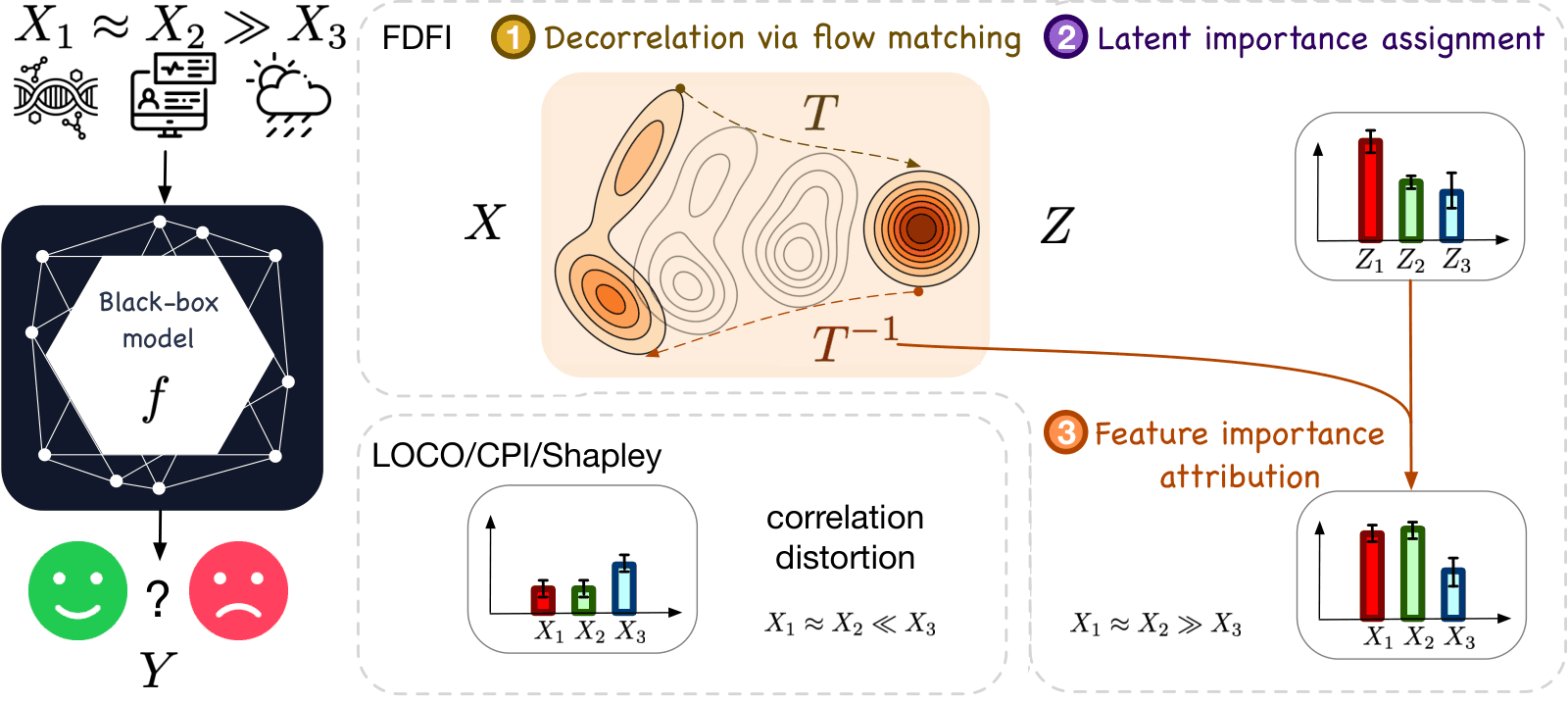
FDFI (Flow-Disentangled Feature Importance) is a Python package for model-agnostic feature importance with statistical inference, with a SHAP-like API. It maps correlated features to a disentangled latent space with optimal transport or normalizing flows, measures importance there, and attributes it back to the original features. This avoids the distortion that correlated features cause in LOCO and conditional permutation importance.
- Three Explainers, One API:
OTExplainer(Gaussian OT, the fast default),EOTExplainer(entropic OT for non-Gaussian and mixed-type data), andFlowExplainer(normalizing flows for complex non-linear dependence). - Statistical Inference: Cross-fitted estimates with standard errors, confidence intervals, and FDR/FWER multiple-testing correction.
- Diagnostics: Reports latent independence and distribution fidelity, each labeled good, moderate, or poor, so users can check the disentangling map.
- Visualization: Summary, confidence-interval, diagnostics, and correlation plots.
sklearn_ensemble_cv
sklearn_ensemble_cv is a Python module for accurate and efficient cross-validation of ensemble models, such as extrapolated cross-validation (ECV) and generalized cross-validation (GCV).
- Flexibility: Builds on scikit-learn to support a wide range of base predictors.
- Risk Estimation and Hyperparameter Tuning for Ensemble Learning: Creates ensembles of models, tunes them with cross-validation, and makes predictions with the ensembles.
- Evaluation Utilities: Evaluates the performance of the ensembles and of the individual models in them.

No software matches this filter.